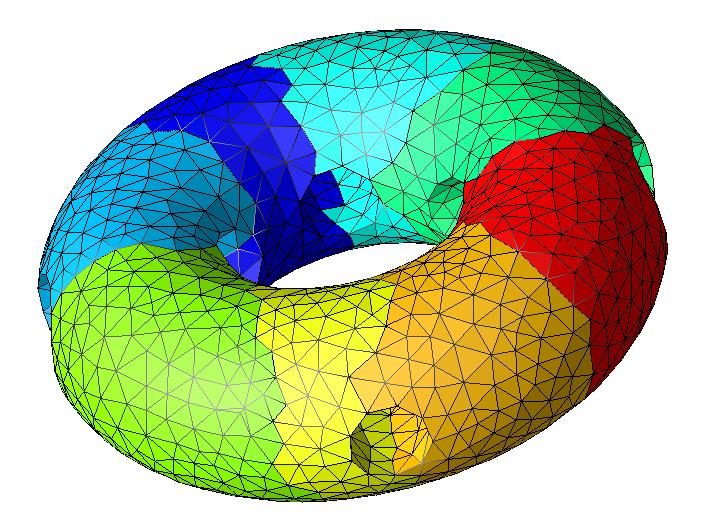
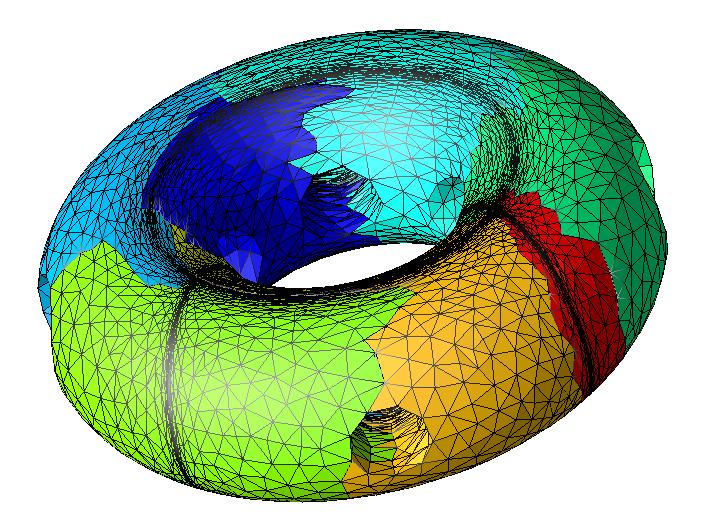
* Example: a torus with four circular holes. The left is the initial mesh and the right is an adapted mesh with two spherical shocks. Different colors represent different processors.
| The data structure of the mesh strongly influences the overall performance of the engineering simulations as it is an infrastructure system executing underneath to provide all the needed mesh-based operations including distributed mesh operations on parallel computers and dynamic mesh load balancing. Development of scalable applications with complex distributed dynamic data structures is a challenging undertaking due to complexity from non-trivial computational capabilities. |
| As for the effort toward the scalable engineering simulations on distributed environments, we addressed this challenge by developing a distributed mesh data management infrastructure that satisfies the needs of distributed domain of applications. To achieve a good compromise between the storage and computational costs, the distributed mesh data structure is designed to be flexible in terms of mesh representation to easily switch between various representations for different phases of an application. The FMDB is embedded in the SCOREC simulation packages efficiently supporting parallel automated adaptive analysis of meshes with billions of elements on massively parallel super computers such as ANL & CCNI BlueGene. |
| FMDB is being used in various scientific/engineering applications as for a mesh data structure running underneath effectively supporting parallel mesh adaptive loop. |
| The FMDB is supported by the U.S. Department of Energy's Scientific Discovery through Advanced Computing (SciDAC) program as part of the Interoperable Tools for Advanced Petascale Simulations (ITAPS) center. The FMDB was developed to be ITAPS compliant and represent core functionalities of the ITAPS meshing tools. |
|
* Example: a torus with four circular holes. The left is the initial mesh and the right is an adapted mesh with two spherical shocks. Different colors represent different processors. |